
What makes America great? Ingenuity, freedom, and a political-economic system that supports creativity. Committed people take new ideas, combine them with the time and money of others who believe in a novel proposition, and produce something that will change the fortunes of those involved with the effort, if not the lives of the rest of us. Following this pattern, American entrepreneurs, inventors, bankers and financiers, men and women of letters, the leaders of movements, and politicians at particular moments have charted new directions in the course of our history.
We are at a moment now when this American quality of innovation and enterprise will change our future. While not the focus of headlines, our natural environment will be impacted, perhaps profoundly. The 150 year-old movement to conserve nature on our continent will soon be directed by the individuals and organizations that reflect the American spirit, which has both promise and danger in its character.
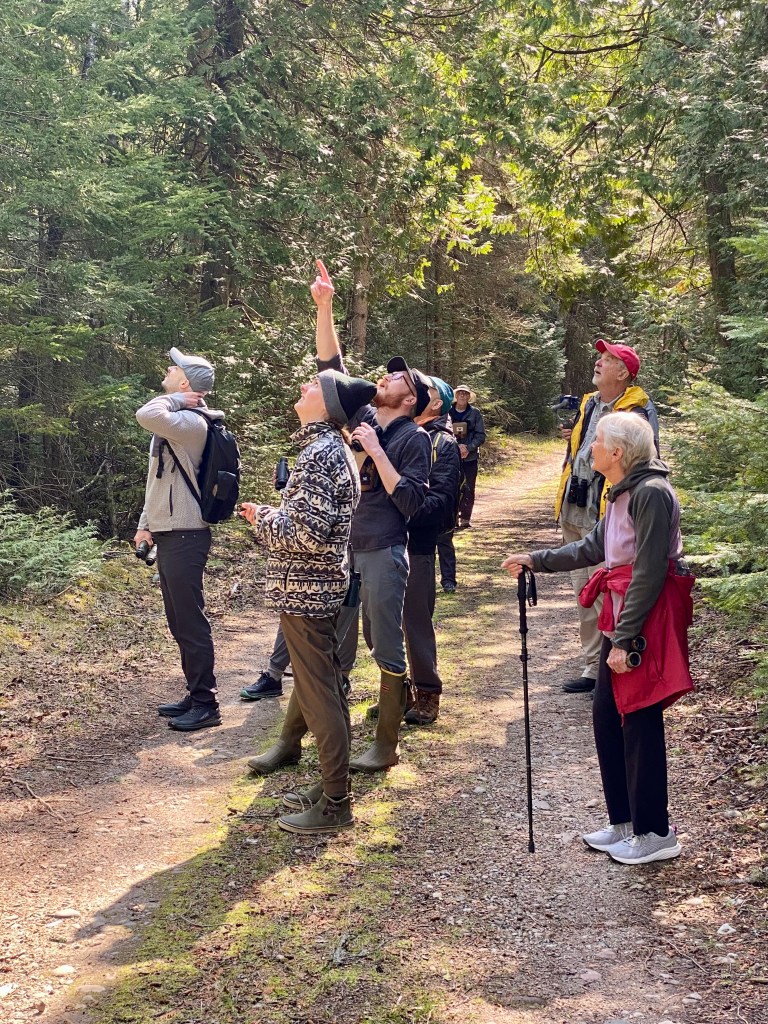
Warblers. I was thinking these thoughts the other day while looking at warblers at North Point, a wild peninsula extending into Lake Huron on the right side of Michigan’s left hand. The sun glared, the air was brisk, and we were walking down a narrow gash in the woods that held a worn two-track. Suddenly, the air became alive with flying objects, zipping overhead, dancing into the trees, and exciting our small group.
“Black and white in the birch tree on the left.” “Yellow-rumped in the pine.” Both delivered in flat voice. Then, “Oh! Oh! Black-throated green high on the left. There, moving down the trunk.” After a long walk up the beach and scattered discussion of ducks and gulls the group of strangers were now bunched together, elbows out and up, and heads bobbing; there was some jostling for position. “Right out there in the open.” “Got it!” “What a beauty.”
Misnamed, the black-throated green warbler is distinguished by it’s bright yellow head, set off against a dull green back, and a dark throat, fairly unique characteristics among the parulidae family of birds. There are 53 species of warblers in North America, and many of them spend their summers in Canada; all of them spend their winters in warmer places: the Gulf Coast, the Caribbean, the Yucatan, Central America, or even the edges of the Amazon rainforest.
The variety of warblers excites even the most casual of bird-watchers. Flipping through a guide, one stops at the pages with the colorful pictures and the strange names: chestnut-sided warbler, redstart, Kirtland’s warbler, northern parula, and the warblers named after places: Nashville, Canada, and Cape May. But in the field, they are usually rare sightings: most live north of us, and we see them only when they migrate. And they tend to stay high in the branches, and flit around, making it hard to get a good look at them. But in May, they show up before trees fully leaf out, in bright breeding plumage, and in large numbers. It’s the best time of year to go birding in the Great Lakes region.
North Point, just east of Alpena, collects migrating warblers, as do several other peninsulas along the shores of the Great Lakes. Birds, on their way north follow the coastline, hopping from forest to forest, following the first warmth that causes midges and other insects to hatch and offer food to the hard-working birds. When they come to an open stretch of water they sometimes pause, waiting for the right wind to fly across the waves, and then make landfall at the first opportunity. North Point, curving around and down into Thunder Bay, offers warblers a place to rest and refuel.
Point Pelee on the north shore of Lake Erie, and Tawas Point 60 miles south of North Point, are both popular places to watch the spring migration of rare warblers because they are parks, open to the public. Communities nearby enjoy the influx of tourists. North Point, mostly in private ownership, has not hosted many birdwatchers. Recently that changed, and thus I found myself walking the shoreline of Thunder Bay. The story of how that change occurred points us to the future of American innovation in conservation.
The history of conservation in America can probably be benchmarked to the creation of Yellowstone National Park in 1872, though antecedents can be located in the work of scientists, writers, and artists going back much further. Decades after the efforts of President Theodore Roosevelt and many others, author Walace Stegner called national parks “America’s best idea” as the concept deepened in the United States and spread around the world. Parks were accompanied by national wildlife refuges, national monuments, and designated wilderness areas. States copied and expanded the idea. The second national park, on Mackinac Island, was transferred from federal to state ownership in 1895. (Read my review of the book Terry Tempest Williams wrote on the 100 year anniversary of national park service)
While National Parks are administered by the federal government, the creation of most of them resulted from a partnership with private landowners, nonprofit organizations and advocacy groups. State and local governments have sometimes supported, and sometimes opposed, the creation of national parks. This mirrors the history of natural resource conservation in our country, with various units of government, individuals, and a wide variety of environmental organizations playing roles that lead to the protection of wild lands, rivers, rare habitats, sites of historical and cultural significance, coastal and off-shore waters, and scenic transportation corridors.
The protection of North Point came about because of a partnership between the National Oceanic and Atmospheric Administration, a federal agency that manages the Thunder Bay Marine Sanctuary, and numerous nonprofit organizations. The Nature Conservancy, one of the largest non-governmental organizations in the world, worked for over a decade to secure the funding to purchase 1,384 acres of North Point in 2017 from a group of sportsmen who owned the property. They turned the property over to Huron Pines, a regional conservation group, who now acts as steward of this special place.
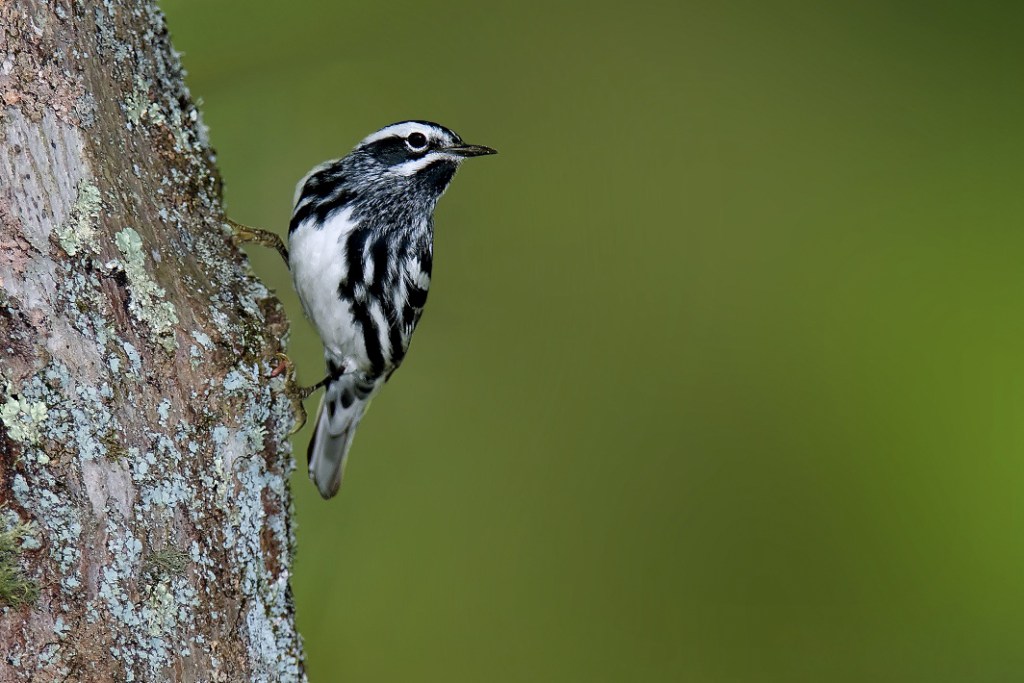

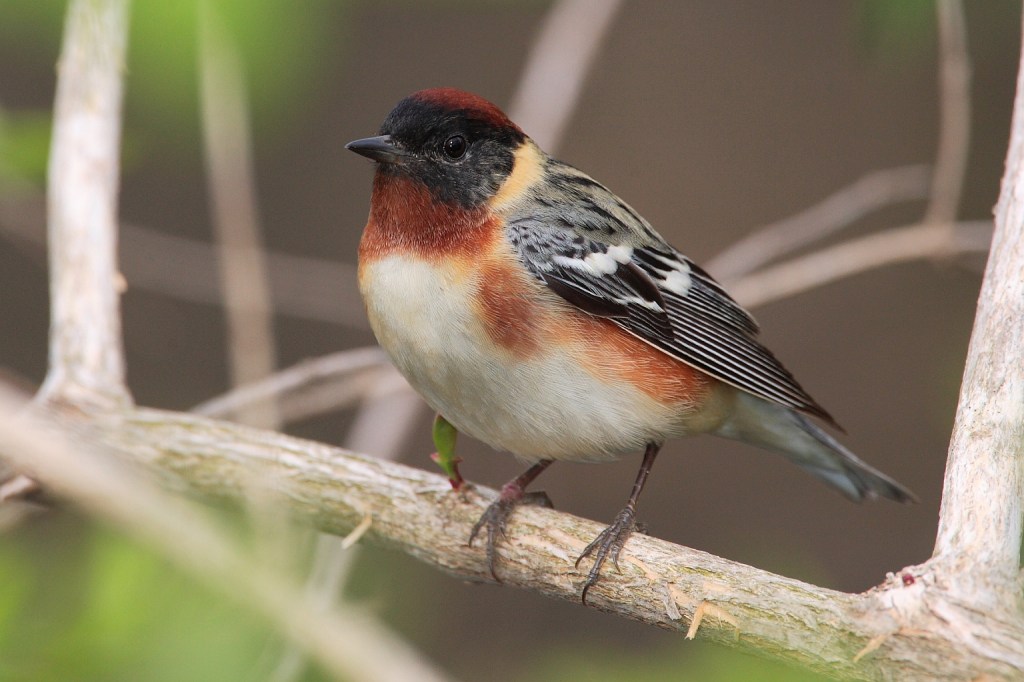
We need nonprofit conservation organizations. And just like the variety of warblers streaming north through the Great Lakes, we need all kinds of groups doing a range of environmental work in all sorts of places. We need big non-governmental organizations to hire scientists and policy experts and to raise funds from discerning donors and large-scale philanthropy. North Point would not have been protected without the heft of The Nature Conservancy. We need stewardship experts like Huron Pines who care about their particular corner of the world and do the painstaking, day-to-day work to protect and improve particular places. And we need volunteer-driven groups to deliver on the ground workers; the Thunder Bay and Grand Rapids chapters of the Audubon Society turned out the passionate experts who led the comprehensive count of migrating birds the weekend I visited North Point.
Just like the discipline of the free market, or the political milieu of democracy, some nonprofits succeed in the real world, and others fail. Some attract lots of contributors, others are good at getting grants from philanthropic groups, and some hang on with just a few large donations. And while most rely on private funding, a few get significant government grants to carry out tasks that the public sector is poor at executing. Some nonprofits build huge, active memberships and stage rallies and turn out voters. Others avoid confrontation and work quietly behind the scenes. A few work to sue governmental agencies and private companies when they fail to live up to legal or moral standards. We need them all.
Several decades ago I heard David Brower give a talk on my college campus. He had been a charismatic leader of the Sierra Club, and then over some dispute (inevitable in any human-run entity) he quit, or was fired, and formed the Friends of the Earth. Someone in the crowd asked a question, perhaps to trick him, “Which environmental group is the best? Which group should I join?” I took his answer to heart. “Join as many as you can,” he urged, noting that the more members a group has, the more clout they have. After that, when I got my first job in 1983 I joined The Nature Conservancy, the Environmental Defense Fund, the Natural Resources Defense Council, and many more groups. I have been a member of these groups ever since.
When I started visiting places that inspired me, I joined “Friends of” and other groups focused on unique geographies, national parks, or rivers. My allegiances, and donations, have gone up and down over the years based on the changing programs, new initiatives, and the times. I moved away from an area, and my connection waned, or I met an impressive leader and my giving increased. Moving back to my home town in 1996, I found there was no local conservation group, so I helped start one (the Friends of the Shiawassee River).
Here’s my point, and plea: if we are to protect the environment, conserve nature, and ensure the places that we love endure into the future, we need to support conservation organizations of all stripes, and the more the better. We are in a time in our nation when we are re-examining the role of government, especially the large federal agencies involved in caring for nature: the Environmental Protection Agency, the National Oceanic and Atmospheric Administration, US Forest Service, and the Department of Interior and its critical components of the National Park Service, Bureau of Land Management, and the Fish and Wildlife Service. The efforts of citizens, from all walks of life, organized together were responsible for the creation of many of these public protectors. And the nonprofit sector continues to partner with government to jointly further a conservation mission. Now, the nonprofit sector needs to advocate for a new (or revived) role of the federal government, point out challenges, and try and fill in some of the inevitable gaps.
That is not to say all environmental groups get it right all the time. Mistakes made in strategic direction, overlooking the interests of indigenous people, historic racism, unwise accommodations with certain donors, confusions of political goals with conservation outcomes, missed responses to serious environmental threats, and missed opportunities to expand the number of supporters have all set back certain nonprofits. Currently, Audubon chapters, each their own legal entity, are wrestling with whether to change their name in recognition of their founder’s troubled history around slavery. Some have changed, others have not; time will tell which decision was the right one.
And this is the strength of American nonprofits. Like the ecology of the places they seek to protect, nonprofits evolve to meet the times. The groups that succeed will reflect the energy and donations of conservationists who choose to be active. So, take an assessment of the world around you, think about how positive change occurs, and do what you can to promote your favorite environmental group: volunteer, give money, talk up their work to friends and family. Then repeat, with another nonprofit working in another way or in another place. Give to international groups, regional nonprofits, and your local “Friends of (your favorite place here).” Give to an advocacy organization, support a land conservancy, help fund science, hire lawyers, or whatever you know to make a difference.
The world is a big place. We are each but one person, but none of us are insignificant. As Margaret Mead said “Never doubt that a small group of thoughtful, committed citizens can change the world. Indeed, it is the only thing that ever has.”.

 Walks with Tom
Outside Magazine reports that donations and volunteer activity for nonprofits that support specific National Parks has increased as funding and staffing has been cut at the National Park Service https://www.outsideonline.com/outdoor-adventure/hiking-and-backpacking/national-park-nonprofits/
LikeLike