
Instructions for living a life: Pay attention. Be astonished. Tell about it. – Mary Oliver
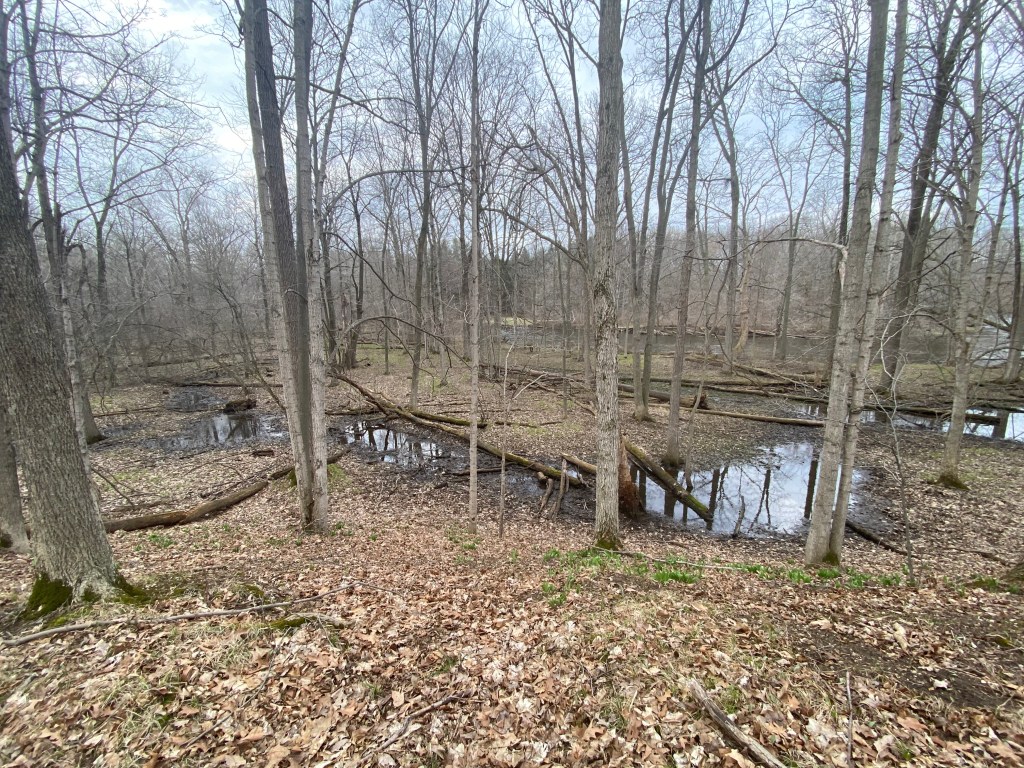
The world is a big place. Its salvation will come from little locations, small acts, and tiny plants. In the niche of the world I live in, along Michigan’s Shiawassee River, winter grudgingly relinquishes control sometime after the vernal equinox. A few warm days in late March are countered in April with a freezing night or two and some snow, sleet, and cold rains.
On a spring expedition to a floodplain bend, I encounter bare trees, dead leaves, and black water. Only a few bright patches of green stand out in the bleak monotony of the forest floor recently freed of snow. Ken – my friend with a map and GPS watch – and I are attracted to the stands of wild leeks, allium tricoccum, or ramps as those in the know call them. One of the first plants to push up after dormancy, they are prized by wild foragers for their sweet garlic-tasting root bulb and bright green leaves which saute nicely with scrambled eggs or trout. By June the leaves will shrivel, leaving no sign of this forest delicacy.
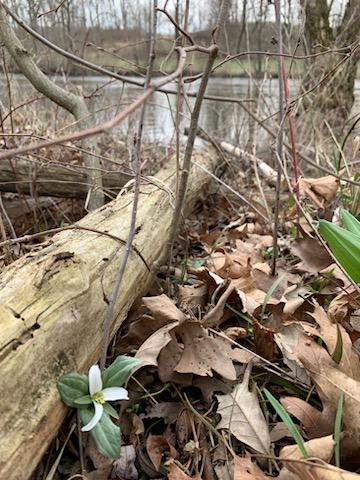
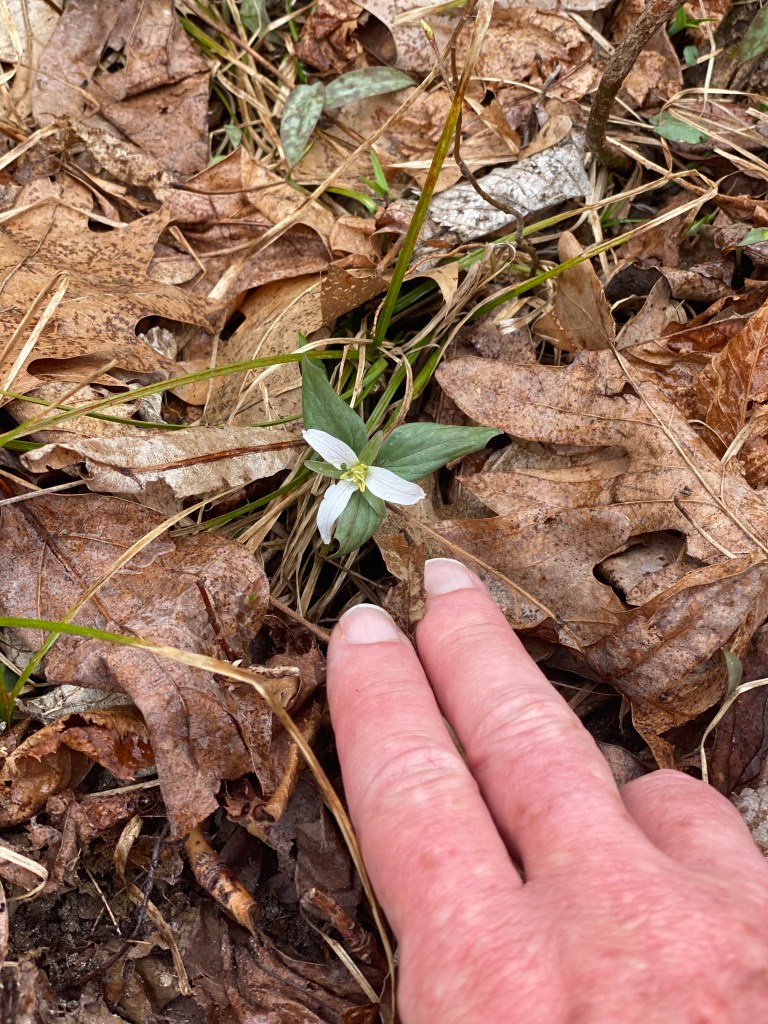
On this trip we are not looking for food. Rather, we are on a quest for an even more elusive plant. Snow trillium have been found in only 10 places in Michigan, according to the definitive Natural Features Inventory maintained by Michigan State University. This small wildflower arrives well before its much bigger cousin, the common trillium, trillium grandiflorum. The tiny version, trillium nivale, stands less than two inches tall, with small dark green leaves and a bloom with three narrow white petals no longer than the second digit of a finger.
As is typical of many wildflowers, the snow trillium prefers rich soils in deciduous forests. But it’s not an up-north wildflower, and in my State it grows only along a few rivers in mid-Michigan. It is particular about the dirt it grows in, preferring calcareous soils on top of gravel or with limestone debris.
There is one recorded location of the snow trillium in the Shiawassee River watershed, and we are using data from an old map with hopes of finding this little treasure. Straight property lines overlaid on a twisting river require us to make a convoluted hike, but the quirks of ownership have also protected this place from development.
Where are the snow trillium? Around us the woods, gray as the sky, are a mixed stand of red oak, maples, and a few pines. A tangle of downed trees, curved honeysuckle limbs, and pant-ripping multiflora rose cover most of the dead ground. Eyes fixed downwards, we pick our way to the bank of the river and proceed on a low bench cleared somewhat by winter floodwaters.
And there, where the forest opens up, we see several small patches of ramps on the second bench of the floodplain. We go close, stop, and look. There, among the four inch high ramps, we spot a small group of three leaves, so dark that their green blends more with the dark hummus than the wide blades of the ramps which tower over them. The small leaves of the four plants in a row are distinctive. And then, a foot away, another set of leaves hold what appears to be a bloom. The white petals are so narrow that I am not even sure this is a flower. But the magic number of three, a memory of a photo, and the specifics of the time and place leave me certain that this is the rare snow trillium.

Our place in the world can be difficult to determine. Where should we locate our concerns and spend our time? As the internet shrinks the globe, we know in fine detail what is happening in Ukraine, Wuhan, or Washington sometimes more rapidly and completely than what is happening in our hometown. I yearn to make a difference, but how can I when our biggest problems are global?
This place, these woods, are unremarkable by the standards of “Nature” presented in glossy calendars, BBC documentaries, and enhanced Instagram posts. Today the colorless sky spits rain and the sounds of trains and trucks intrude as I stand on feet numb in wet and muddy boots. I feel as drab as the day.
I am here because of my personal history and inescapable genealogy. Behind my back less than ten strides away is a river I canoed with my grandfather, and then my father, and then my children. Five decades of paddling with not only family, but friends old and new, has tied me to this place. Something more, something that comes from time spent outdoors and knowledge gained from others, grounds me here. The Shiawassee flows north, to join with four other rivers to make the short and deep Saginaw River, and then onto Lake Huron, second biggest of the Great Lakes, the premier freshwater ecosystem on the planet.
Time is no longer abstract this damp morning. I have known of the location of these snow trillium for more than a decade, but have never seen them. I am only now discovering them because a person committed to survey work came here more than 40 years ago, and made notes about what they found. Worried that these rare plants have disappeared, Ken and I have ventured forth and have affirmed that they remain here on the banks of the Shiawassee.
But what of the future? The threat of global climate change overwhelms me when I read the news, or the detailed assessments of scientists from around the world. It can leave me as cold as an April morning. But there at my feet, the snow trillium, found among dead forest detritus, reminds me that life persists, that beauty can be found anywhere, and that hope has a home.
We are creatures in a place, and what ties us there can be a body of water, a geologic feature, or a petite plant. These simple but powerful features of nature connect us to something bigger than ourselves. We may not be able to comprehend the planet, but we can find a small wildflower, or know a woods, or paddle a river. And this is enough.
To save the earth we only need to know our place and take action to care for it. So, on Earth Day – and every day to follow – look around and marvel at where you are. Seek out and enjoy some small sign of nature: a bird at the feeder, a tree in the park, or a wildflower in the woods. Observe and feel how this small piece of nature connects you to the larger world. What will save this place for your children and all the generations to come? We now know that protecting this land, or preventing the pollution of the air and water around it, or tending to the unique species inhabiting it, is but the first step. And the individual actions we take: what to buy (and not buy), how to move from here to there, where to give our time and treasure, and who to vote for matters a great deal.
“Pay attention. Be astonished. Tell about it.” Don’t be silent in your appreciation of nature. Talk about the place you love, and why. Of course share with your family – and those friends as close as family – the stories of nature, the secret spots you treasure, and the grand places that have moved you. But also share your affection for natural places with neighbors, acquaintances, and colleagues; maybe even the elected officials who represent you.
Too much divides us, but our love of place can unite us. Sunsets are not partisan, water cannot be constrained by political boundaries, and the beauty of nature avails all. To protect our found places, we must save the planet, the most special place of all.
A version of this essay was first published in 2022. Since then the land has been protected with a permanent conservation easement.

 Walks with Tom