
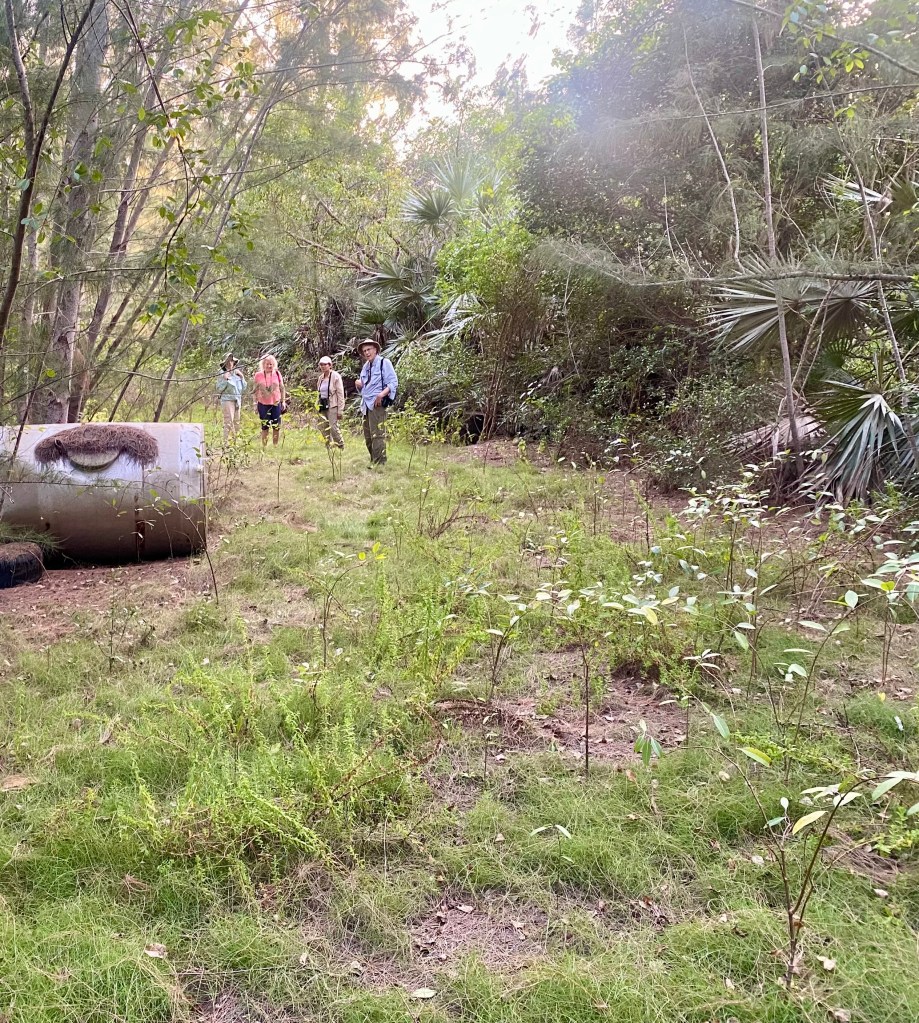
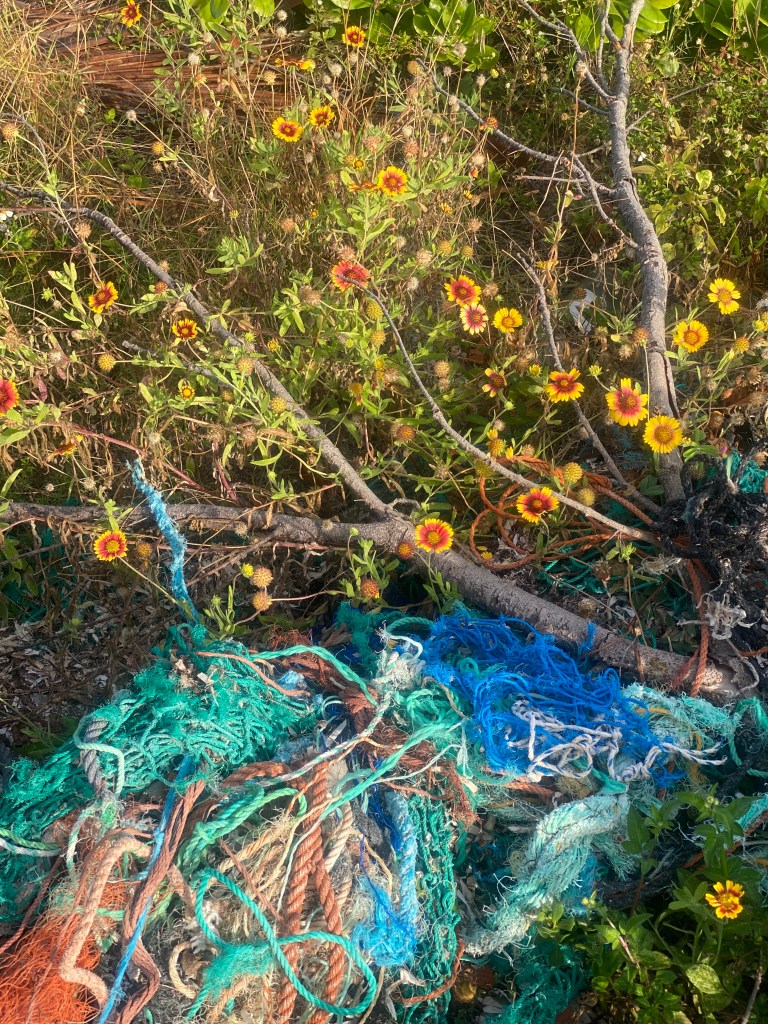
This must be a mistake. As we look for the rare Kirtland’s Warbler we squeeze through a gap in a broken gate of chain-link fencing, the angled opening constrained by a heavy, brown chain. We are in tropical Eleuthera, a green strip of island stretched amidst the Bahama blue sea. We pass a grey pond framed on one side by disturbed soil and on the other by a three-foot high hedge of trash, rusted cars, and persistent vegetation. Here, late in the afternoon, no life moves.
So many missed opportunities. First on the island of Abaco, then earlier in the day along an old two track, where the vegetation was not too dense. In summer, the few Kirtland’s Warblers left in the world breed in the scrubby jack pine forests along the sandy plains above the Au Sable River in Michigan. And in winter, upon return to the Bahamas, they don’t like to inhabit areas where the vegetation is too tall or too thick. The most reliable place to find the warbler on Eleuthera? On a goat farm.
We pass some rusted machinery of unclear purpose, three discarded dune carts with only the painted roll bars still showing bright aqua and pink, and an abandoned chicken coop. On most of the 31 inhabited islands in the Bahamas, the population is thin and many an economic dream has yet to be realized. Half-finished resorts, cleared lots empty except a junk car, cinder-block foundations sprouting a crop of rusting re-rod, and other signs of the vain efforts of humans to break into Eden, tame the environment and make a claim on paradise.
We need a story of hope. In North America, the population of songbirds—which include warblers, robins and other thrushes, finches, and sparrows—are in dramatic decline. Ornithologists have serious concerns about a third of bird populations, and 112 species have declined by 50 percent or more in the last 50 years. There are fewer birds because there is less habitat: forests have been cleared, wetlands drained, prairies converted to farms, and unique places diminished by changing climates or invasive species. “Birds tell us that we have a full-on emergency across all habitats,” said Marshall Johnson, chief conservation officer at the National Audubon Society.
For a bird especially particular about its habitat, the situation is dire. The Kirtland’s Warbler builds its nest on the ground under young jack pines. The cones of these thin and scraggly trees, which have little commercial value to humans, open to release their seeds only after fire has burned the exterior. Before Smokey the Bear became a mainstay of forest management, nature would periodically burn the aging scrub forest that grew on the sandy plains left by the glaciers in northern Michigan, Wisconsin and Ontario.
Every summer, pairs of Kirtland’s Warblers find the places where new jack pine forests have become established and raise a family under the small trees. In winter, the warblers, young and old, fly south to warm tropical areas, specifically to some low islands in the Bahamas.
It’s the summer of 1971, and a census is undertaken of the Kirtland’s Warbler (also called the KW or Bird of Fire), and birders struggle to find only 200 singing males. Assuming they all could find a mate, the population is estimated to be only 400 birds. In 1973, as the Earth Day movement spreads, the Endangered Species Act is signed into law by Richard Nixon. The Kirtland’s Warbler is on the list.
With the alarm raised and empowered by the law, government wildlife officials, scientists, foresters, bird advocates, and environmental activists study the habitat, breeding behavior, and threats to the KW. After some mistakes and some successes, they realize they have to create new jack pine habitat by clearing old forests and planting them anew. After several decades of effort, breeding habitat expands, and the population increases ten-fold to more than 4,000 birds. In 2019, the Kirtland’s Warbler is “de-listed,” a testament to the power of the Endangered Species Act to make a difference. The law works.
Before de-listing from the protections of federal law, those working to save the KW knew that on-going efforts to create and maintain habitat would be necessary; the Kirtland’s Warbler is a “conservation-reliant” species. That’s when I first heard the story of the KW and became enraptured by this small yellow bird that demonstrates that we can make a difference through our conservation efforts. “The story of the Kirtland’s Warbler reminds us that human interaction with nature does not always result in extinction and loss” I wrote in 2014, after several trips to see the bird around Mio, Grayling, and Roscommon (read my account here).
In the Bahamas, the Kirtland’s Warbler spends it winter mostly on Eleuthera, Cat, Long, San Salvador, and Rum Cay of the the many islands that make up this archipelago on the other side of the Gulf Stream from Florida. The Bahamas rest on an ancient sea that, like much of northern Michigan, formed into limestone. Since then, shifting sands, changing weather, hurricanes, and the vagaries of seeds and animal behaviors have created diverse island ecosystems. Humans have found home on about 32 of the islands, but just one, New Providence, has a big city, Nassau, that accommodates about 75 percent of the nation’s population.
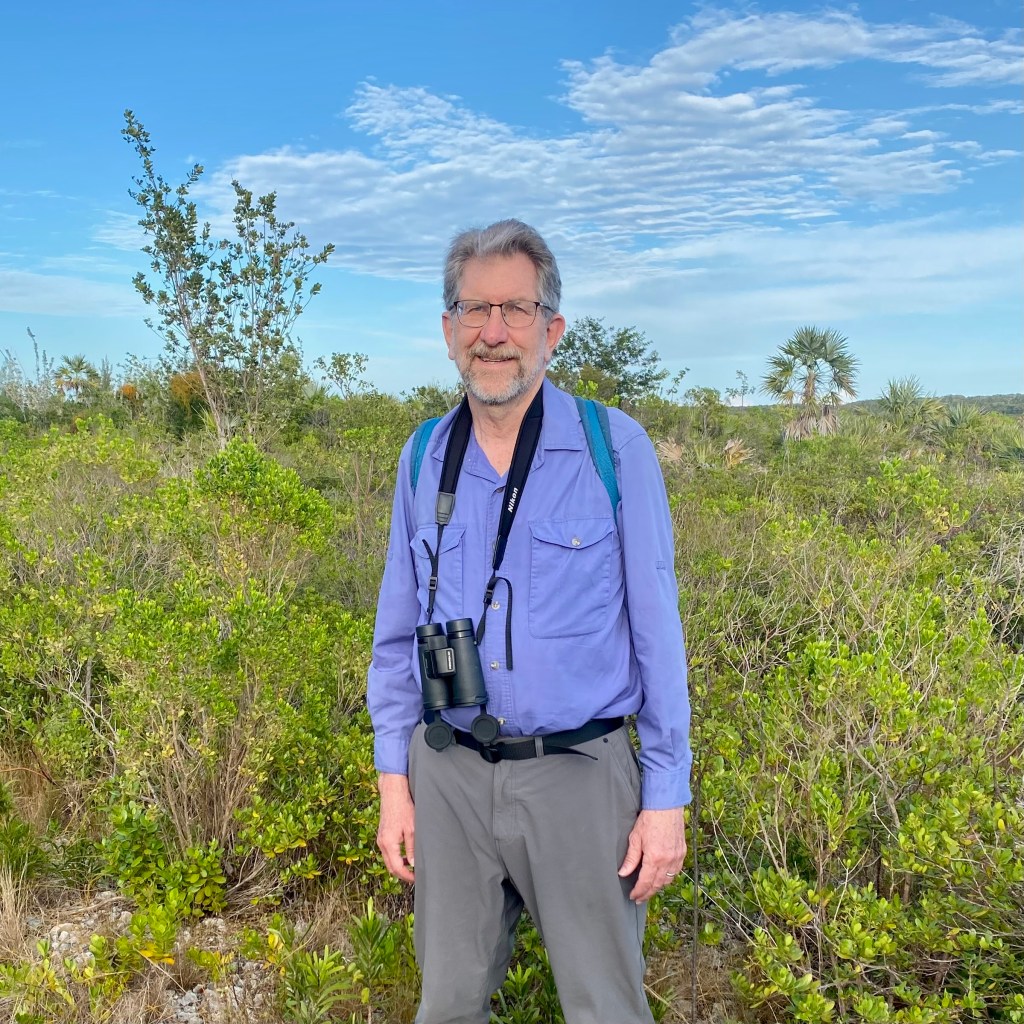
This winter, I realized a goal of the last decade and visited two of the islands where the Kirtland’s Warbler has been found. My partner Anna and I found our way there with a group from American Bird Conservancy, now the lead organization working to protect the habitat and promote the survival of Michigan’s rarest songbird. Though first observed in the Bahamas in 1841, no one was exactly sure where it wintered until this century when the work driven by the Endangered Species Act sent conservationists out looking among the many islands of the archipelago.
One of the highlights of the trip to the Bahamas was meeting Eric Carey, former head of the Bahamas National Trust, who worked with Dave Ewert of The Nature Conservancy and Joe Wunderle of the US Forest Service to find the winter homes of the Kirtland’s Warbler. In addition to persistent fieldwork, these men also worked to build conservation capacity by training Bahamians, bringing them to work in Michigan and help them get university degrees in the United States. There’s now a next generation of locals working for the Bahamas National Trust and the American Bird Conservancy (ABC) on Eleuthera and elsewhere. (See this video which tells the story of KW conservation by Bahamians)
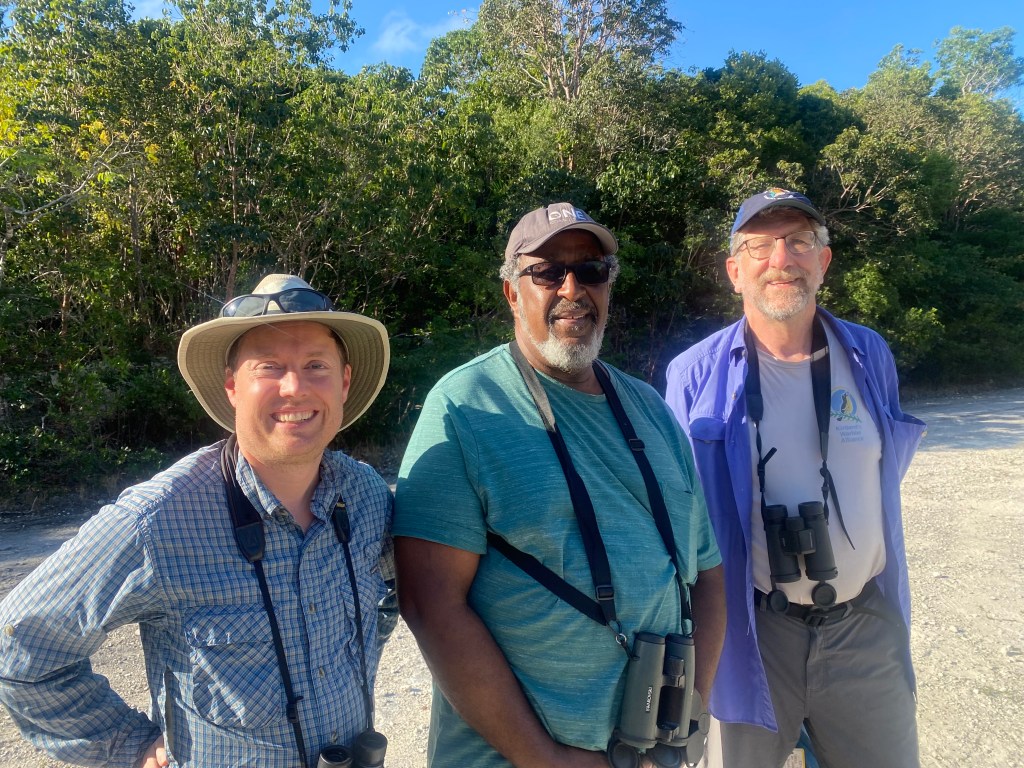
Informed by the work of scientists, and with the expert guidance of Steve Roels of ABC, we began our quest for the Kirtland’s Warbler with an experienced group of birdwatchers from New York, Chicago, and beyond. After several days of exciting additions to our fellows’ life lists (the Olive-capped Warbler, the Bahama Warbler, and the Bahama Woodstar to name but a few) we are now on Eleuthera in search of the Kirtland’s Warbler. To find these rare avian species, we explored a Caribbean Pine forest, peeked into dense coppice of tropical shrubs, and walked slowly along empty roads.
Birds though are an adaptable, even resilient, animal and while human ignorance, destruction of habitat and unchecked hunting have doomed the Passenger Pigeon, Carolina Parakeet, and Bachman’s Warbler (among others), some birds thrive, or at least survive, in human habitats. On our trip, we found the White-winged Dove perched on power lines outside our hotel, the Western Red-legged Thrush at a backyard feeder, and the Cuban Amazon—a spectacular, 12-inch tall parrot—in a loud flock in a residential neighborhood. So, I wasn’t surprised when I heard that the KW would best be found on a goat farm.
Still, I doubted our quest as we pass through the evidence of human disregard for nature. We turn a corner after picking our way through a patch of invasive rubber vines and encounter another fence; beyond it the vegetation is free of litter. We unhook the fence of wide-squared wire and roll back a section to allow entry onto an overgrown road. Another fence, concealed by vegetation, parallels the path on the left. On our right, low vegetation stretches on to a dune-shaped hill in the distance; a few palms slightly taller than people scatter across our view.
Closer, informed observation reveals we are in a goat pasture, though no animals are visible, having been rounded up at the end of day of grazing. The vegetation is shorter on our side of the fence because of the goats, even though it looks like a natural landscape. Apparently, the goats prefer some species over others; two of the less-favored bushes—white sage and black torch—have small berries which feed the Kirtland’s Warbler.
This is the place. We call in the birds, and after a few minutes a streak of grey and yellow zings past us. Binoculars up. “There. On that branch,” someone says, not trying to point. “See how he pumps his tail?” These veteran birders are kind, and work hard to make sure everyone gets a view of the rare bird. “Here. Step left. Look through that window in the hedgerow.” Slowly we shuffle around, trying to get a clear view. Then the warbler jumps to a perch on a fence wire. “Yes! And an enthusiastic whispered response, “Oh, oh! Such a beauty.”
Smaller than a robin, but bigger than most warblers, the KW is particularly striking with a full chest of lemon yellow, almost neon against grey sides and highlighted with a few dark spots. The beak is dark and pointed with a black mask extending to big eyes accentuated by a white ring broken in front and back. Thin legs are almost invisible against the foliage and twigs.
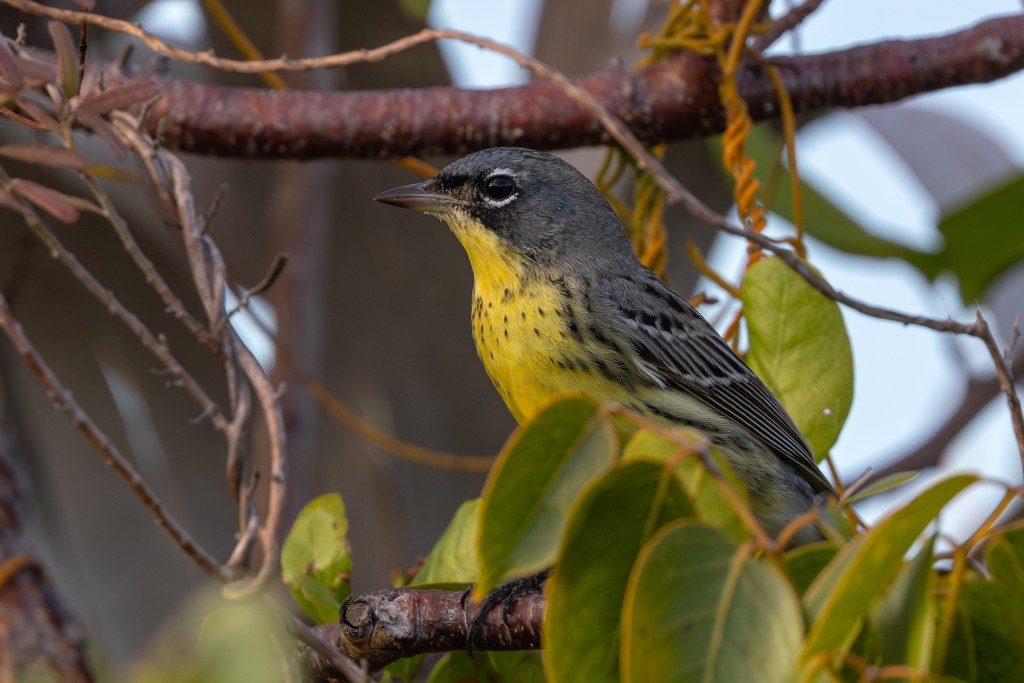
“Hope is a thing with feathers” wrote Emily Dickinson, “that perches in the soul,” in one of her short poems that expresses our longing to belong, to find affirmation in a world that is unsettled, marred, and filled too often with despair. Are we on what Dickinson once called a “goalless road” traveling in ignorance? Somedays it feels that way to me. The data and forecasts on climate change are frankly depressing, especially when so much of current politics and statecraft heightens my anxiety. Fear, division, and the inability to address, much less resolve, the most basic and immediate of problems, chases away hope.
Thus, a few less songbirds doesn’t seem like that big a deal. The sea is rising, storms sweep across the land, fires rage and destroy neighborhoods. What future do we build in such a world? The weed-infested path, the half-built house, remind me that many of our attempts are vain grasps for a better world. Someone once asked me if the resources spent to save the Kirtland’s Warbler are worth it. “Couldn’t we make better use of the money?”
But here, at the end of sunny day in the Bahamas, amidst quiet joy, the blue sky invites escape. We’re no longer worried about the overgrown path, the despoiled landscape, the broken gate, the missed opportunities, the changing climate, or the future much beyond the next five minutes.
Intellectually, we do know how fortunate we—and the Kirtland’s Warbler—are to be here. The recovery of the bird is an impressive story that builds upon an amazing history of discovery, perhaps best told by William Rapai’s book “The Kirtland’s Warbler: The Story of a Bird’s Fight Against Extinction and the People Who Saved It.” The subtitle includes the hopeful news about how people came together and brought strong science and their best efforts to figure out why the KW population was in decline and how to reverse the trend.
The Kirtland’s Warbler’s story is our story. How do we come together to understand the world we depend on? We need to collaborate—each of us with our own experience, perspective and talents—to preserve not only the rare species, but our own. We can find the answers, even in small things. We can find and protect our home.
To learn more, and support the protection of the Kirtland’s Warbler and other birds, visit the American Bird Conservancy.
To be one the voices speaking up for the Kirtland’s Warbler, join the Kirtland’s Warbler Alliance

 Walks with Tom
Beautifully written, Tom!
LikeLike