
The weather in Michigan gifted us a wonderful summer this year, and I found time to read outside on the shore of Lake Huron and along the Shiawassee River. A dry start to the season dented the annual onslaught of annoying insects, and a relatively cool July and August created some wonderful times of respite, even with a few smoky days thrown at us by Canadian wildfires.
A few severe storms at the end of August did damage to some neighboring homesteads and caused a sewage overflow in my beloved river, but it was still a summer to celebrate. The sweet corn and tomatoes that always mark the end of summer were tasty, and poignant reminders of the importance of farming — a climate dependent industry — to our way of life.


Two books with off-putting primary titles claimed my attention this past season: Dan Egan’s “The Devil’s Element: Phosphorous and a World Out of Balance” and “The Swine Republic: Struggles with the Truth about Agriculture and Water Quality” by Chris Jones, the recently retired, but not retiring, research chemist from the University of Iowa. Together, they have me thinking hard about the future of agriculture in the two watersheds I love most: Saginaw Bay and the larger Great Lakes.
Our climate is changing, I heard two scientists say more than a decade ago1. They were from two of Michigan’s premier research universities and they explained how the heating of the globe would manifest in Great Lakes weather. This dry summer punctuated by storms is what they predicted. Our relatively mild temperatures have led some to call our region a “climate haven” with predictions of an influx of new residents. So far, population numbers have not shown any growth in Michigan, but the continuation of heat waves, fires, and hurricanes elsewhere may yet spur migrants to relocate here.
The world is small, and what happens here connects us to elsewhere, and vice versa, especially when we add the dimension of time. If we don’t come to terms, soon, with the fossil fuel use that causes climate change, the summers won’t be so nice here in the near future. Already our winters are too warm, and the ice on our lakes isn’t forming as extensively or in some places not at all. “Climate action now” must be our mantra.
The two books I read only obliquely touch on climate, though warming weather and increased precipitation exacerbate the water quality problems that both authors seek to alert us to. Dan Egan, a Wisconsin journalist, previously wrote a strong regional book, “The Life and Death of the Great Lakes” but his latest effort takes a global perspective on one particular—and paradoxical—source of water pollution: phosphorous. Chris Jones focuses on water quality in Iowa, where phosphorous is a problem, but so too is nitrogen. Both authors are concerned with how agriculture impacts water quality, especially in a warming world.
Plants need both nitrogen and phosphorous to grow; without them we would not have food to eat. Farmers have long sought to boost agricultural output, or make farming possible in poor soil, with the application of fertilizers, both natural and manufactured. Nitrogen exists all around us in the atmosphere, and some plants like alfalfa can take nitrogen out of the air and leave it in the soil as part of their growing. Nitrogen fertilizer can also be manufactured through a high-energy process of heat and pressure; currently, most nitrogen fertilizer is manufactured using natural gas as a feedstock.
Phosphorous, however, is limited in supply and no industrial process produces it. Dan Egan provides a fascinating account of both the alchemist’s discovery of phosphorous and the use of bones, guano, and minerals mined from the ground, and—to a degree—the recycled use of animal and human waste to provide phosphorous fertilizer. “Phosphorous is the elemental link that completes the circle of life. Literally nothing else can do its job.”
Egan sounds an alarm over the limited supply of the world’s phosphorous: 70 to 80 percent of known reserves come from Morocco, and the Western Sahara, a part of the world forcibly occupied by Morocco. It’s a finite resource like fossil fuels, and when the geological phosphorous created eons ago by the death of miniature sea creatures are used up, there is no alternative source.
Despite its biological importance, and the tenuous nature of its production, phosphorous is the bad boy of the worst water pollution in our headlines: algal blooms, and in particular the blue-green algae outbreaks that produce toxic microcystins. I was aware of the Lake Erie outbreak that poisoned the Toledo water supply in 2014, but Egan also recounts other deadly algal blooms in Florida and in the northern Gulf of Mexico in 2019. The latter was particularly unique in that blue-green algae does not survive in salt water: the bloom along the Gulf beaches was only possible because of the flood of polluted freshwater from the Mississippi River.
Tracking the source of that polluted freshwater, which annually creates a “dead zone” in the Gulf of Mexico off Louisiana, takes us upstream to the home of Chris Jones. Iowa, the 32nd largest state in terms of population, is number two in agriculture output (second to California). Mostly Iowa grows corn and soybeans (and hogs, cattle, and poultry) and those crops take a lot of fertilizer. Corn in particular benefits from nitrogen, and Iowa farmers use a lot of it. Although the Hawkeye State makes up less than five percent of the land area (and is the source of about six percent of the water) in the Mississippi Basin, it contributes 29 percent of the nitrogen and 15 percent of the phosphorous in the Gulf.
Chris Jones explains, with lots of documented data and solid analysis, the sources and causes of this water pollution and the problems it wreaks on fish, state parks, and humans. He is a clear writer, and can turn a phrase to really bring home an issue. Like this one: “Nitrogen is the beer of the nutrient world. We drink a lot of it, spill a lot of it, and maybe get a little sloppy in the process. Phosphorous, on the other hand, is more like tequila. A couple of shots and before you know it, you’re dancing on the table and trading your clothes for beads.”
Jones examines many other causes of poor water quality (industrial farming practices, over-application of fertilizer, heavy use of drainage tile, and corn production for ethanol) and their impacts. Much of his attention, rightly, is given to the plight of Des Moines and the Raccoon River, where this major metropolis gets most of its drinking water. Legislative proposal, outside advocacy, and a lawsuit filed by the Des Moines Water Works against upstream drainage districts have not resulted in any action to reduce the water pollution, and the public utility spends millions of dollars annually to remove nitrates from the drinking water. There’s more complexity to all this, but Jones sums up his research and analysis with the observation that “the drinking water consumed by 25% of the state’s population is impaired from the best crop land on earth farmed by some of the state’s most prosperous farmers who are customers of the powerful agribusiness interests.”
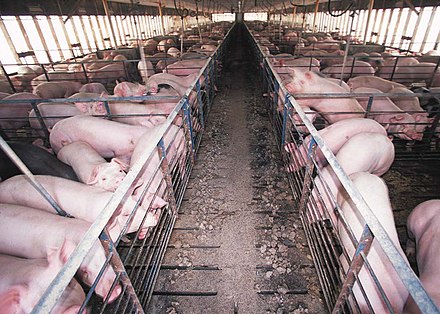
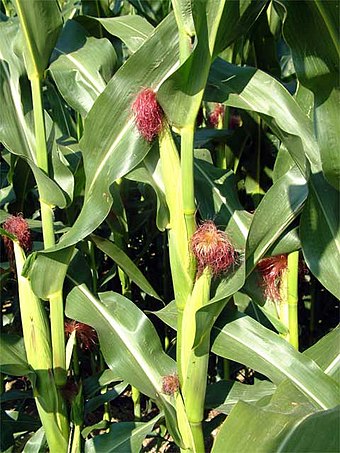
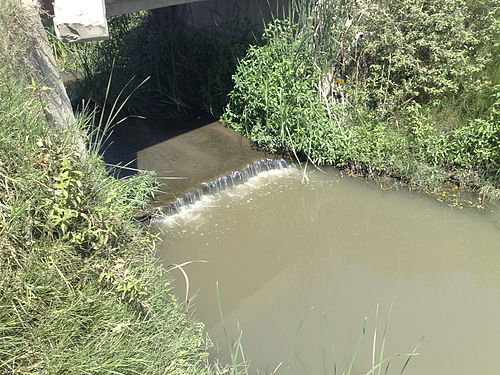
Hogs, and drinking water, are the issues that most concern Chris Jones. The book “Swine Republic” is a compilation of blog posts he wrote over the years 2019 to 2022, and the most (in)famous was one entitled “Iowa’s Real Population.” He notes that while Iowa’s has three million people, there are 20-24 million hogs in the state, about a third of all the hogs in the country. From a water quality standpoint, he identifies the real problem: pigs produce more than three times as much solid waste, three times as much phosphorous, and five times as much nitrogen waste as a human. And while human waste must be treated before it is released into the environment, no such requirement exists for hog waste, or the excrement of cattle or poultry. Almost all of it gets spread on the land, with only the most minimal level of oversight by a governmental body.
Farming has changed was the thought I had time and again reading “Swine Republic.” When I studied geography in college some four decades ago, the maps of the Midwest showed lots of “mixed agriculture” where no crop was dominant. Family farms raised a rotation of crops and mixed in livestock to supplement their income. A diverse agriculture landscape has been changed into industrial operations run by fewer farmers, raising more bushels of corn (mostly) and bringing many more animals to market. However, the increase in productivity has not benefited the farmer. In the last 50 years, the average number of bushels per acres of corn has doubled, but farmers receive only 15 cents for every dollar spent on food in this country; in 1973 they made 40 cents of every dollar spent.
From a water quality standpoint, the biggest challenges are the over-application of fertilizer and the management of manure. If the quest is always to maximize yield, then the marginal cost of adding a little more nitrogen makes sense to someone growing corn for which pork, beef, and ethanol producers will willingly buy. The efficiencies of a concentrated animal feeding operation (CAFO) logically lead to the factory-scale production of livestock. The manure that results can be used to fertilize fields, but it is not economic to transport the mostly liquid waste very far. The inherent difficulties in manure management from a CAFO, especially at the watershed level, quickly turn a lot of animal waste into an externality: water pollution that downstream neighbors, cities, and habitats have to absorb.
An easy response to the paradox of fertilizer, including manure, is to blame the farmer, but Chris Jones, who once worked for an agricultural trade association, goes out of his way not to criticize individual farmers. He is sympathetic to the economic and political structures that defines their world. A complex system of market interventions, global trade, and bi-partisan politics have compelled increased agricultural production with little benefit to farming families. “Why have they gone along” ask Jones of farmers “with largely relinquishing the benefits of increased productivity while being forced to absorb the blame for the water problems connected to this increased productivity?”
What to do about the conundrums of modern agriculture? Fertilizer is necessary, but it befouls our water. Global markets support US pork production, but depress prices thus requiring CAFOs to compete. Federal ethanol policy creates a bigger market for corn, but the resulting ethanol really does nothing to reduce climate impacts. Farming has gained more political power, but uses it to support an industry that doesn’t provide an economic entry point for young farmers. Chris Jones and Dan Egan painfully point out many of these paradoxes that bedevil farming as mostly practiced today.
The paradox that personal struck me the most was Jones’ essay on Lake Darling. Iowa has fewer lakes than 44 of the states, and thus the State of Iowa constructed several, including an impoundment in 1950 that was named after wildlife conservationist Ding Darling, an Iowa native (a bird-rich National Wildlife Sanctuary in Florida is also named after him). Several times, the Iowa Department of Natural Resources has invested million of dollars in restoring the lake, and worked with landowners in its watershed to adopt practices to reduce erosion and nutrient runoff. However, within a mile and a half of the lake are 19 fields where manure is regularly spread, and weak regulations of this practice (and other water quality problems) resulted in Lake Darling having the recent “ignominy of being the only place in Iowa with both e.coli and microsystin advisories.”
Both Jones and Egan offer some solutions to the water quality created by industrial agriculture. Egan only dedicates one chapter (out of nine) to solutions while Jones has more and more specific recommendations. But they agree on two things. 1) Regulate modern agriculture; and 2) End government support for ethanol production. Half a century ago, when the Clean Water Act was adopted to control pollution from industry and municipal sewage disposal systems, agriculture was exempted from the law. “The failure of the Clean Water Act,” writes Egan “to adequately police the agriculture industry is at the root of today’s wave of algae infestations because the fertilizer washing off agricultural lands is a primary driver of the algae blooms.”
These recommendations have not been well received by the agricultural industry. Jones, in particular, has been subject to quite a bit of vitriolic criticism. The primary problem with regulating agriculture are the thousands of individual farms with varying conditions across large geographies, though, as Jones documents, the number of farmers has decreased while the size of their farms, and animal feeding factories, has increased.
Still, the farming community is well organized politically and has effectively forestalled any serious discussion of the imposition of rules or regulations. Witness the decades long legal controversy over wetlands regulation in the Clean Water Act. While not a topic covered in depth by either author, the last several presidential administrations have attempted to clarify the seemingly simple term “waters of the United States” as it relates to waterways and associated wetlands but have been unable to adopt a definition that is workable for state and federal agencies and acceptable to farmers. This has left the courts to decide these issues. Congress could easily adopt legislation to settle matters, but the divide between the agricultural and environmental communities in a partisan legislative branch prevents such a resolution.
Rather than regulation, a few others idea come to me as I think about my 25 years of working on water quality and agriculture issues in the Saginaw Bay region. Egan and Jones from their respective vantage points of history and Iowa force any reader to question how we farm, use land, and protect water. In particular, “Swine Republic” pushes me to re-examine several assumptions I have had about the agricultural world and how change there might occur. Both authors define problems that already challenge the status quo of agriculture in American; we cannot continue as we are now.
After my summer’s reading, eating, and thinking hard about the climate, I come away with three recommendations about how to improve farming, at least in the midwest. To better address both climate change and water quality issues, we must redesign the agricultural system based on current realities, we have to find ways to support those farmers that embrace their role as stewards of the land, and we need to build stronger local food economies.
1. Systems Solutions. We all live, work, and consume within economic, political, and cultural systems. While we all work to understand our place in the world, both physical and metaphysical, our actions are constrained by the larger structures we inhabit. We may personally want cleaner water and a healthier climate, but individually there is only so much we can do. Farmers, like all of us, can only make so many choices, and if we want them to choose particular agricultural practices (I.e. what to grow, where to grow it, and how to grow it), we need to help create an agricultural economy that rewards positive behaviors.
Chris Jones recognizes this, and his writings often compliment the 1985 Farm Bill legislation that tied federal crop insurance to Conservation Compliance which prohibits providing subsidies to farmers that plow steep slopes, floodplains, and wetlands. Farmers grow corn for ethanol on 11,000 square miles in Iowa (60,000 nationally) because the federal government largely mandates the manufactured corn alcohol be added to gasoline. The rules we adopt often determine the outcome of the game.
More positively, there is now a push to change farm systems to promote “regenerative agriculture” that promote soil health and encourage more carbon to be retained in the fields where our crops are grown. Egan gives attention to the provocative idea of using human urine, high in phosphorous, as fertilizer. Better science and innovation are part of better systems. The ingenuity of the agricultural industry caused some of our problems, and it’s economic power can hopefully correct our course. Jones and others are skeptical, but if both old practices and new technologies can be wisely paired with the right market cues, then the potential is great for agriculture to reduce both water pollution and the warming of the climate.
2. Farmer Networks have proven to be an effective way for those who care for the soil to come together to learn, share, and support one another. Farming is a way of life handed down from generation to generation, often in the same place following traditions that change only slowly. While those who make their living from the soil of course respond to payments and rules from both governments and buyers, they also live in a community. In the Saginaw Valley, and elsewhere, providing support for groups of farmers to learn the latest, compare notes with others, and share labor and equipment can help them be the best stewards of the land.
While Egan and Jones document the industrialization of the agricultural landscape, and its negative effect on our natural world, I do not believe individual farmers want to create these problems. Farmers are trapped within their systems as much as we are trapped in systems that require us to burn fossil fuels to travel to work or visit distant relatives. The only way any of can effect change is by working with others. The Nature Conservancy has shown that bringing together conservation-minded farmers, and providing them with knowledge, can create a positive force for better farming.
3. Local Food. It’s not just the agricultural landscape that has been industrialized, so too have our supermarkets become commercialized. We as consumers expect to find a full range of food available year round, at low cost, that is quick to prepare. We could do a lot to diminish the negative environmental impacts of our food systems if we were to eat more foods grown locally and in season.
This change does not come easily, but there can be great benefit, and joy, in taking the time to appreciate and acquire foods grown locally. The slow food movement, farmer’s markets, farm-to-table restaurants, and growing your own food all reduce the carbon footprint of food, and literally enrich our communities and diets. For me, eating with the seasons in mind, buying produce for half the year through a local farmer’s CSA (community supported agriculture) subscription, and canning and freezing all have helped me appreciate food and where it comes from. Lots of studies (here’s a good one) will show that being a vegetarian is good for the environment, but I like to buy meat raised locally by small-scale farmers and I eat fish from the Great Lakes.
Importantly, we need to build systems that support the farmers who live near us to grow crops and raise animals that they can sell locally and in a way that supports them economically. I am impressed with the new consignment models like Argus Farm Stop that provide a strong, year-round market for local food producers. It’s clear from Dan Egan’s critiques and Chris Jones’ analysis that we need to shift more land away from the dual crops of corn and soybeans. Diverse crops and local food economies have helped more farmers, especially young and entrepreneurial ones, enter into business and earn a living from food.
Summer is over, and I have several obligations before me that will cut into my reading time. Students are back in school, the number of meetings and conferences have increased, and our elected leaders have reported for work. One of the tasks that awaits a divided Congress is renewing the Farm Bill, which expires September 30. This federal legislation, which has long enjoyed bi-partisan support, will authorize subsidies to farmers and consumers alike. Crop insurance, trade provisions, and conservation programs help farmers to maintain their fields and grow food. The Supplemental Nutrition Assistance Program (SNAP, or food stamps) provides assistance to lower income families to buy the food produced.
The complex Farm Bill defines the economic systems in which farmers grow food while also being the largest environmental program funded by the Federal government. Over time, great good has been created by the Farm Bill, and now more than ever we could use its policy framework to build a sustainable agricultural system that supports farmers, improves the quality of food we eat, and minimizes the impact of agriculture on water quality and our climate. Certainly whatever Congress can pass this fall will not solve all our problems, but it is a good place to start.
- Jeff Andresen, Professor of Geography at Michigan State University (and the State Climatologist spoke at a convening of the Saginaw Bay Watershed Initiative Network; David Allan of the University of Michigan’s (now renamed) School of Environment and Sustainability spoke to a gathering of trustees of The Nature Conservancy in Michigan.
↩︎

 Walks with Tom